Drone Attacks in Colombia: What Are the Risks for Businesses?
Drone attacks in Colombia are becoming increasingly frequent as armed groups expand their use of drones. In some areas, the risks extend beyond direct attacks: surveillance of facilities, threats to personnel, and transportation disruptions can all affect business operations.
There were 119 recorded drone attacks in 2024, followed by 277 in 2025. Between January 1 and October 1, 2026, that figure had already reached 318, roughly one attack every 20 hours.² These numbers reflect an unprecedented rate of increase.
Par
Clémence de La Blanchardière
· Publié le
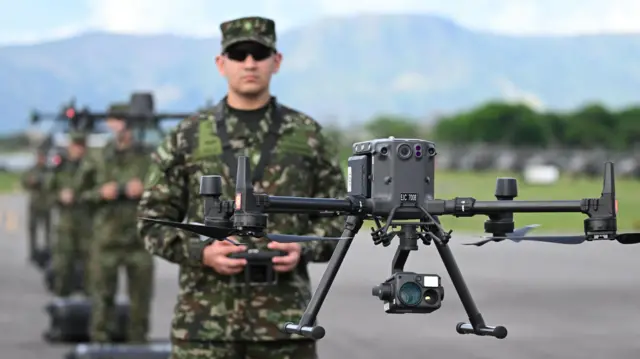
Photo by RAUL ARBOLEDA/AFP via Getty Images
What happens when a drone attack disrupts business operations without directly targeting a company? In Colombia, the growing use of drones by armed groups poses risks beyond direct attacks, including surveillance, threats to personnel, and transportation disruptions.
Drone-Related Threats to Businesses
Armed groups, including the National Liberation Army (ELN) and dissident factions of the Revolutionary Armed Forces of Colombia (FARC), use drones for three main purposes: monitoring activity, exercising territorial control, and carrying out attacks. Many of these devices are commercial drones modified to carry explosives. Their availability and relatively low cost make them easier to acquire.¹
But the threat can begin before an attack. A drone can observe employee movements, equipment, and a facility’s daily routines without passing through its access controls. A single sighting does not establish hostile intent. Repeated flights, however, particularly following a threat or an extortion demand, should be assessed alongside other available information.
A simple reporting process that records the time, location, duration, and observed behavior of each flight helps managers identify patterns and determine what action is needed.
Drone Attacks in Colombia: Geographic Risk Concentration
Between January and May 2026, 121 incidents involving drones and explosive devices were recorded. The departments of Cauca, Norte de Santander, and Valle del Cauca accounted for 65.3% of the total.³
These areas also support significant economic activity. Valle del Cauca and northern Cauca are home to industrial parks and free trade zones, with access to international trade through the port of Buenaventura.⁵
While some areas face greater risks than others, assessments must remain local. Two facilities in the same department may have very different levels of exposure depending on their municipality, access routes, and immediate surroundings.
The consequences also affect local communities and services. During the same period, the United Nations Mine Action Service (UNMAS) reported 21 deaths and 145 injuries, as well as attacks on homes, schools, and gas stations. Civilians accounted for 32% of those killed or injured.³ ⁴ Protective planning must therefore also consider where employees live and how they travel to and from work.
Segovia: A Facility Directly Targeted
On August 3, 2026, explosives dropped from drones struck facilities operated by the El Cogote miners’ mutual association in Segovia, Antioquia. Two people were injured, and infrastructure and freight vehicles were damaged.
According to a preliminary police assessment cited in news reports, the attack may have been retaliation for unpaid extortion demands and failure to attend meetings imposed by an armed group.⁶ ⁷
For businesses facing similar pressure, practical measures include consolidating threats and drone sightings through the security manager, reassessing areas where personnel are exposed, and establishing shelter procedures. An exercise can then verify that everyone knows whom to notify and what to do. These measures aim to reduce personnel exposure and enable a faster response when an alert is raised.
Tibú: Disrupted Operations Without a Direct Attack on the Business
On July 9, 2026, an explosive device, reportedly dropped from a drone, damaged the administrative area of Tibú Airport in Norte de Santander.⁸ The attack prevented the planned resumption of flights between Cúcuta and Tibú. As of September 3, 2026, the service remained suspended.⁹
For businesses that depend on this connection, the disruption can delay construction work, force travel postponements, place additional strain on personnel, and compress project schedules, even when their own facilities have not been targeted.
Preparation means identifying essential travel, designating who has authority to postpone it, and determining which activities can be performed remotely. Any alternative transportation arrangement must undergo a security assessment before use: the closure of an air route does not automatically make road travel an acceptable option.
Assessing Exposure Beyond the Perimeter
The question is not simply whether a facility could be attacked. Businesses also need to identify the people, routes, and services whose unavailability would affect their operations.
Site managers, security teams, and operations leaders can begin with three actions: review local incidents, formalize how reports are handled, and prepare for disruptions to access or transportation. This foundation then helps determine whether additional detection capabilities are needed.
Drone-related threats extend beyond direct attacks to include surveillance, territorial control, and operational disruptions.
Exposure extends beyond company premises: civilians accounted for 32% of those killed or injured between January and May 2026.
Drones are also being used as tools of extortion and coercion.
Indirect attacks can have lasting operational consequences. Business continuity plans should account for disruptions to critical external infrastructure, even when company facilities are not directly targeted.
Protect Your Teams and Operations
On land and at sea, IRENA supports your teams in securing projects in high-risk environments.
From risk assessment to crisis management, we help you anticipate threats, protect your personnel, and maintain business continuity when security conditions deteriorate.
ACLED. Drones are re-shaping armed group warfare in Latin America. August 27, 2026. View source.
Fundación Ideas para la Paz (FIP). Cada 20 horas se registra un ataque con drones en Colombia: ¿cómo responder a esta amenaza? October 8, 2026. Based on military and police records through October 1, 2026.
UNMAS. Flash update: ataques con drones y artefactos explosivos en Colombia. June 2026. Reporting period: January 1–May 31, 2026. Regional percentages calculated by IRENA.
Defensoría del Pueblo. Muerte de dos adolescentes y nuevo ataque con drones en Tibú exigen fortalecer la protección de la población civil. September 17, 2026. Includes UNMAS figures for January–May 2026.
Invest Pacific. Zonas francas, investor supplier directory. Additional source for industrial parks and free trade zones in Valle del Cauca and northern Cauca, and their proximity to the port of Buenaventura. View source.
El Colombiano. ¿Por no pagar extorsiones? El motivo por el cual bombardean mina con un dron en el Nordeste antioqueño. August 4, 2026.
Blu Radio. Ofrecen recompensa por responsables de lanzar explosivos con drones a mina en Segovia, Antioquia. August 5, 2026.
Caracol Radio. Atacan con explosivos aeropuerto de Tibú, en el Catatumbo. July 9, 2026. Drone involvement was reported in preliminary information from authorities.
Defensoría del Pueblo. Atentado contra el aeropuerto de Tibú es una infracción al derecho internacional humanitario y prolonga la desconexión aérea del municipio. July 10, 2026.